What does a lunar eclipse look like from the Moon?
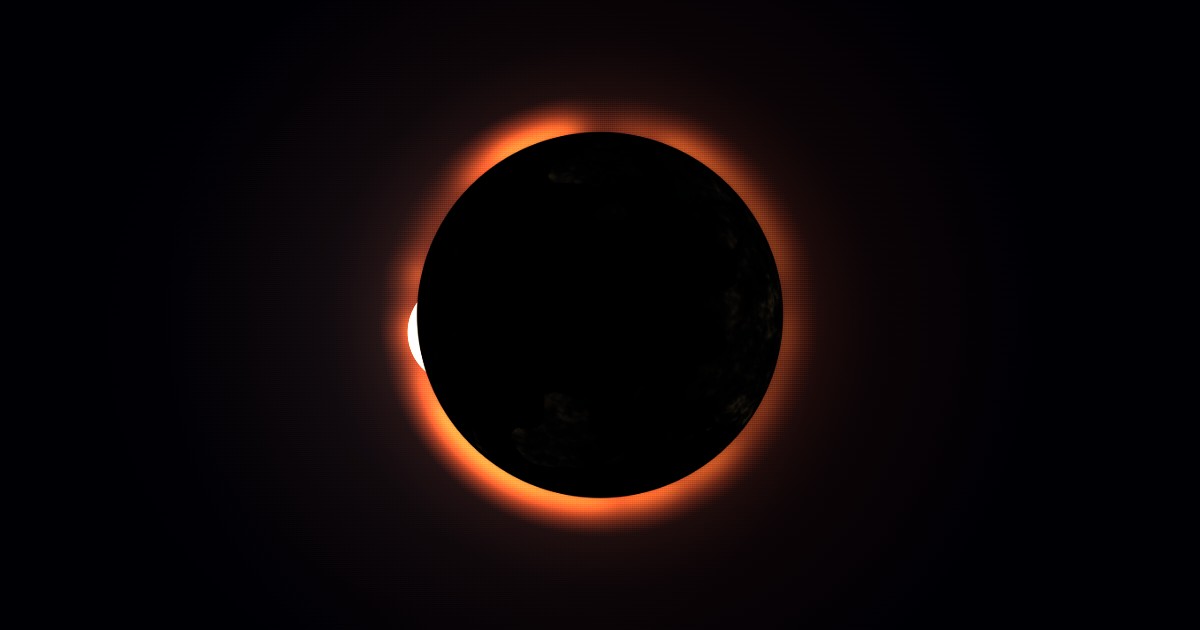
A lunar eclipse is what it is called from down here. Stand on the Moon and it is something else entirely: Earth slides in front of the Sun, and you are the one in shadow. Computed for the eclipse of 6 July 2028.
 Open this exact moment — and move the clock yourself
Live Rendered here and now by the Lunar Aspect engine, not a screenshot. Download free on the App Store
There is no such thing, from up there. What Earth calls a lunar eclipse is the Moon passing through Earth’s shadow — so if you are standing on the Moon, you are not watching the eclipse. You are in it, and what you see is Earth sliding across the Sun.
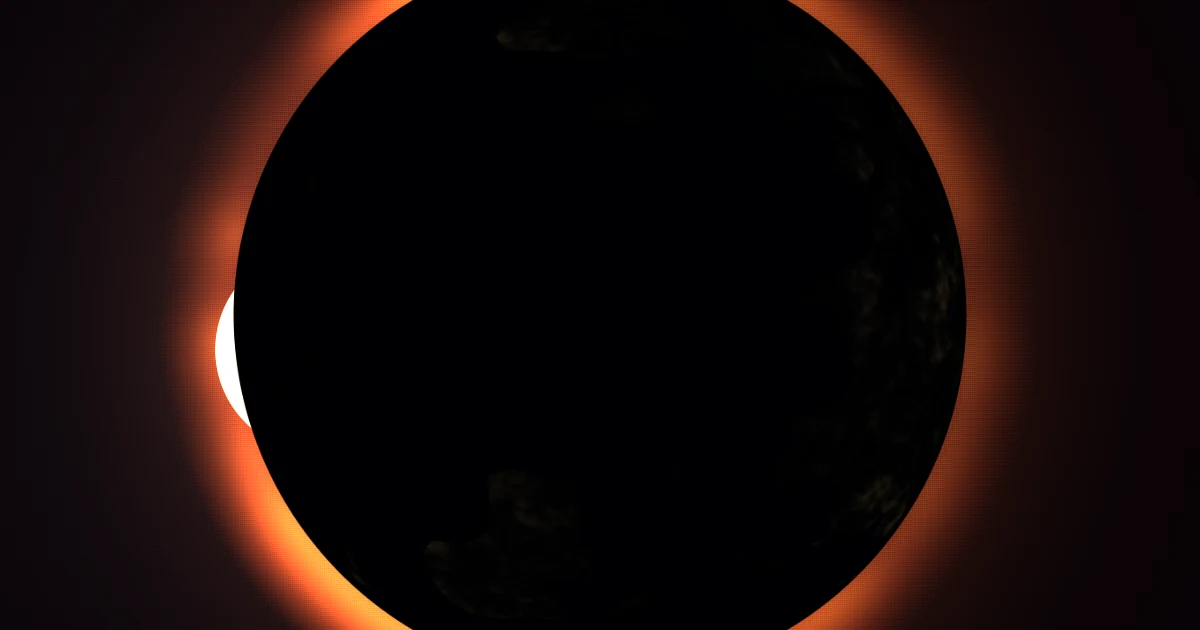
At the deepest moment of the eclipse of 6 July 2028, the engine has Earth covering 94.26% of the Sun, the two discs 0.72° apart, with the Sun 70.8° above the horizon.
Earth is new, and it has to be
Earth is 0% illuminated here — effectively unlit. That is not a detail, it is the whole mechanism. To be between you and the Sun, Earth must have its night side turned toward you, and an object with its night side toward you is by definition new. A full Earth could never eclipse anything, because a full Earth is on the opposite side of your sky from the Sun.
Why it lasts so long
Earth is 1.86° across from here and the Sun only 0.52°. On Earth, a total solar eclipse is a knife-edge coincidence — the Moon and the Sun happen to be almost exactly the same apparent size, so totality lasts a couple of minutes and the shadow is a few dozen kilometres wide. Here there is no coincidence and no knife edge. The Sun is more than half covered for 138 minutes.
From Earth we watch this same event as a copper-coloured Moon. The colour comes from the same place the light does: every sunrise and every sunset happening on Earth at that instant, bent through the atmosphere and falling on the ground you would be standing on.
How these numbers were produced
Every figure on this page came out of the ephemeris that runs inside Lunar Aspect, computed for Tranquility Base at 2028-07-06 18:32 UTC. Nothing here was typed in by hand: the page is generated, and a number that the engine stops producing breaks the build rather than going quietly stale.
| Value | Produced by |
|---|---|
| 94.26% | compute().eclipse.fraction |
| 0.72° | compute().eclipse.separation |
| 1.86° | compute().earth.angRad × 2 |
| 0.52° | compute().sun.angRad × 2 |
| 0% | compute().earth.illum |
| 70.8° above the horizon | compute().sun.alt |
| 138 | scan of compute().eclipse.fraction > 0.5 |
Engine build 84048b2 2026-09-20 ·
page generated 2026-09-19 ·
positions are apparent, referred to the observing site rather than to the
Moon’s centre.
Move the date yourself
This page is one frozen moment. The engine that computed it runs on a phone, at any date, from anywhere on the Moon — the eclipses, the planets, the comets and Earth’s phase, all of it computed rather than canned.