Can you see stars from the Moon during the day?
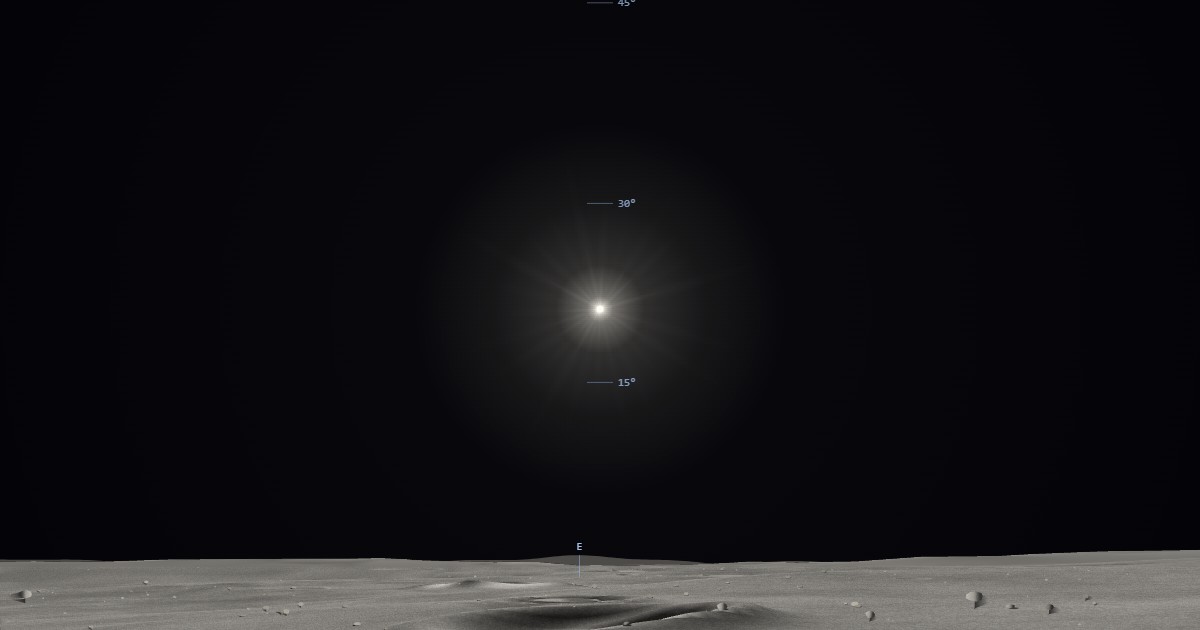
Yes — the sky stays black even at lunar noon, because there is no air to scatter sunlight. Computed: a real moment with the Sun high and stars above the horizon at the same time.
 Open this exact moment — and move the clock yourself
Live Rendered here and now by the Lunar Aspect engine, not a screenshot. Download free on the App Store
Yes. The sky on the Moon is black at every hour of the month, including the middle of the day, and the stars are always in it. In this frame the Sun stands 21.2° above the horizon — 07:25 of a lunar twenty-four, solidly daytime — while Orion’s belt sits 33.2° above the horizon at the same instant.
Our blue sky is the odd one, not theirs
Daylight here does not come from the Sun directly; it comes from sunlight scattered off the air above us. That scattering is what turns the sky into a bright blue lamp and drowns the stars out. Remove the air and nothing is left to scatter: the Sun becomes a fierce point in an otherwise black sky, and everything else stays visible around it.
So on the Moon there is no such thing as a sky that is bright. There is a ground that is brightly lit and a sky that is not, both at once.
Then why are there no stars in the Apollo photographs?
Because of the cameras, not the sky — and this is the one fact that every conspiracy argument about the landings rests on. A photograph exposed correctly for a blindingly lit surface and a white spacesuit in full sunlight uses a very short exposure. Stars are far too faint to register in that time. Point the same camera away from the ground and give it seconds instead of a fraction of one, and the stars appear.
Your eyes have the same problem: look toward a sunlit slope and your pupils close down. Shade your eyes from the ground and the Sun’s 0.54° disc, wait, and the sky fills in. Earth, at 64.1° above the horizon and 54.12% lit, is hanging there through all of it.
How these numbers were produced
Every figure on this page came out of the ephemeris that runs inside Lunar Aspect, computed for Tranquility Base at 2026-10-18 06:00 UTC. Nothing here was typed in by hand: the page is generated, and a number that the engine stops producing breaks the build rather than going quietly stale.
| Value | Produced by |
|---|---|
| 21.2° above the horizon | compute().sun.alt |
| 33.2° above the horizon | toHorizon() applied to Orion’s belt |
| 07:25 | compute().localTime |
| 64.1° above the horizon | compute().earth.alt |
| 54.12% | compute().earth.illum |
| 0.54° | compute().sun.angRad × 2 |
Engine build 84048b2 2026-09-20 ·
page generated 2026-09-19 ·
positions are apparent, referred to the observing site rather than to the
Moon’s centre.
Move the date yourself
This page is one frozen moment. The engine that computed it runs on a phone, at any date, from anywhere on the Moon — the eclipses, the planets, the comets and Earth’s phase, all of it computed rather than canned.