Why are there no stars in the Apollo photos?
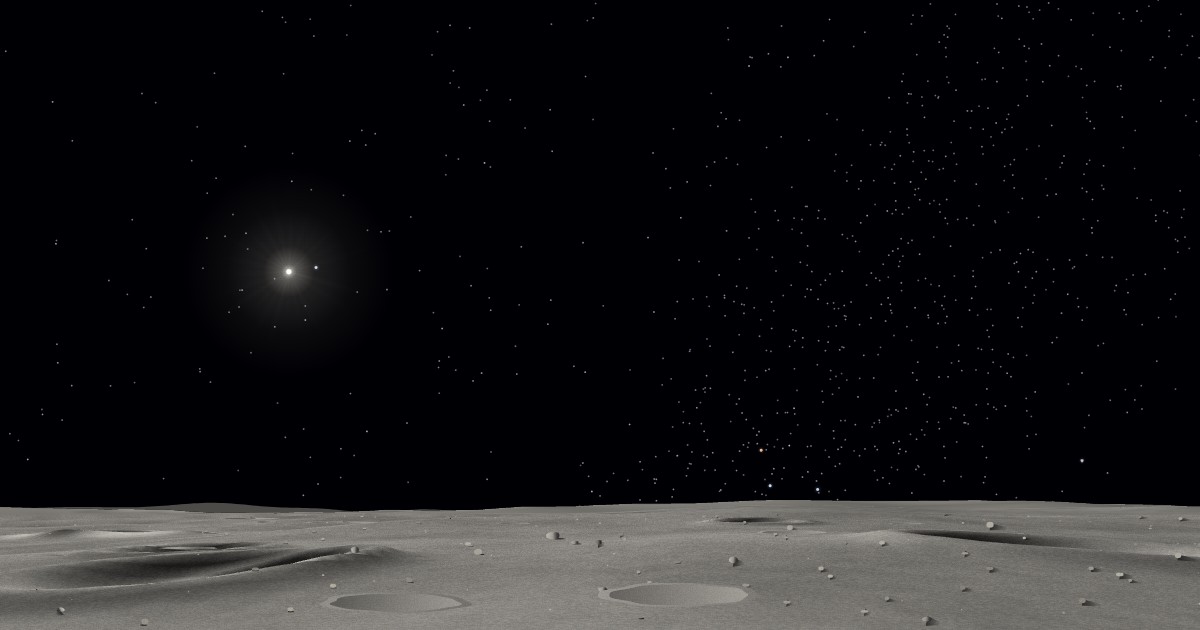
Because the cameras were set for a sunlit surface, not for the sky. The stars were there the whole time — here is a real lunar morning, computed, exposed both ways.
 Open this exact moment — and move the clock yourself
Live Rendered here and now by the Lunar Aspect engine, not a screenshot. Download free on the App Store
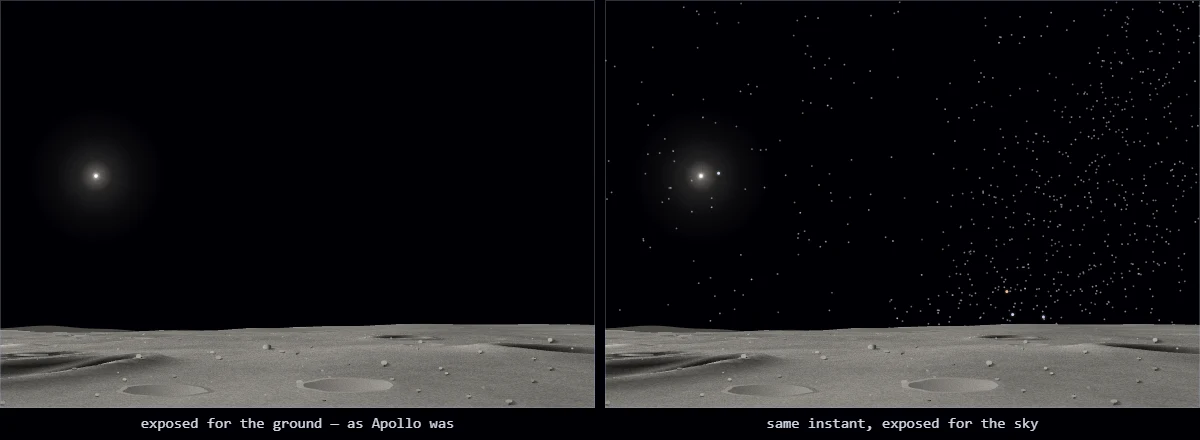
Because the cameras were set for the ground, not the sky. On the surface of the Moon the ground, the spacecraft and the white spacesuits sit in raw, unfiltered sunlight, and a photograph that shows them properly needs a very short exposure. Stars are far too faint to register in that time. They were there in every frame — just not bright enough to record.
The picture above is what the same sky looks like when the camera is set for the stars instead. The Sun stands 21.2° above the horizon — 07:25 of a lunar twenty-four, full daytime — and Orion’s belt sits 33.2° above the horizon at the same instant. The figure further down shows both exposures of that one moment side by side.
It is the same reason your phone cannot photograph stars over a streetlight
Any camera has to pick one brightness to get right. Point it at something brightly lit with a dark sky behind, and it exposes for the bright thing: the sky turns into flat black and anything faint in it disappears. You can see the same effect in photographs of a floodlit stadium at night, or of the Earth from the International Space Station on its day side. The Apollo crews were photographing the landing sites, the equipment and each other — all of it in full sunlight — and the settings that made those pictures work are exactly the settings that erase the stars.
Why the sky is black in daylight at all
On Earth, daylight does not come from the Sun directly; it comes from sunlight scattered off the air, which turns the whole sky into a bright blue lamp and hides the stars behind it. The Moon has no air, so nothing scatters the light. The Sun is a fierce disc 0.54° wide in an otherwise black sky, and the stars stay up alongside it all day long. There is no such thing as a bright sky on the Moon — only bright ground under a dark one.
Could the astronauts see the stars?
Not easily, for the same reason as the cameras. Standing on a sunlit plain your pupils close right down, and a dim star cannot compete with the glare off the ground. Shade your eyes from the ground and the Sun, give them time, and the sky fills in. Earth, meanwhile, hangs 64.1° above the horizon and 54.12% lit through all of it — far brighter than any star, and easy to see.
So the missing stars are evidence of what, exactly?
Of correctly exposed photographs. A picture of a sunlit lunar surface that did show a sky full of stars would be the strange one: it would need an exposure long enough to leave the ground and the spacesuits as a blown-out white glare. The black, empty skies in the Apollo photographs are what a real camera, set for a real sunlit landscape, records.
How these numbers were produced
Every figure on this page came out of the ephemeris that runs inside Lunar Aspect, computed for Tranquility Base at 2026-10-18 06:00 UTC. Nothing here was typed in by hand: the page is generated, and a number that the engine stops producing breaks the build rather than going quietly stale.
| Value | Produced by |
|---|---|
| 21.2° above the horizon | compute().sun.alt |
| 33.2° above the horizon | toHorizon() applied to Orion’s belt |
| 07:25 | compute().localTime |
| 64.1° above the horizon | compute().earth.alt |
| 54.12% | compute().earth.illum |
| 0.54° | compute().sun.angRad × 2 |
Engine build 596b875 2026-09-23 ·
page generated 2026-09-23 ·
positions are apparent, referred to the observing site rather than to the
Moon’s centre.
Move the date yourself
This page is one frozen moment. The engine that computed it runs on a phone, at any date, from anywhere on the Moon — the eclipses, the planets, the comets and Earth’s phase, all of it computed rather than canned.