Watch an Earthrise from the Moon
Apollo 11 never saw one — from Tranquility Base, Earth hangs in the same spot for ever. At the Moon’s western edge it really does rise, once a month. This is the next one, computed and running live: speed it up, slow it down, or zoom in and follow Earth up the sky.
 Open this exact moment — and move the clock yourself
Live Rendered here and now by the Lunar Aspect engine, not a screenshot. Download free on the App Store
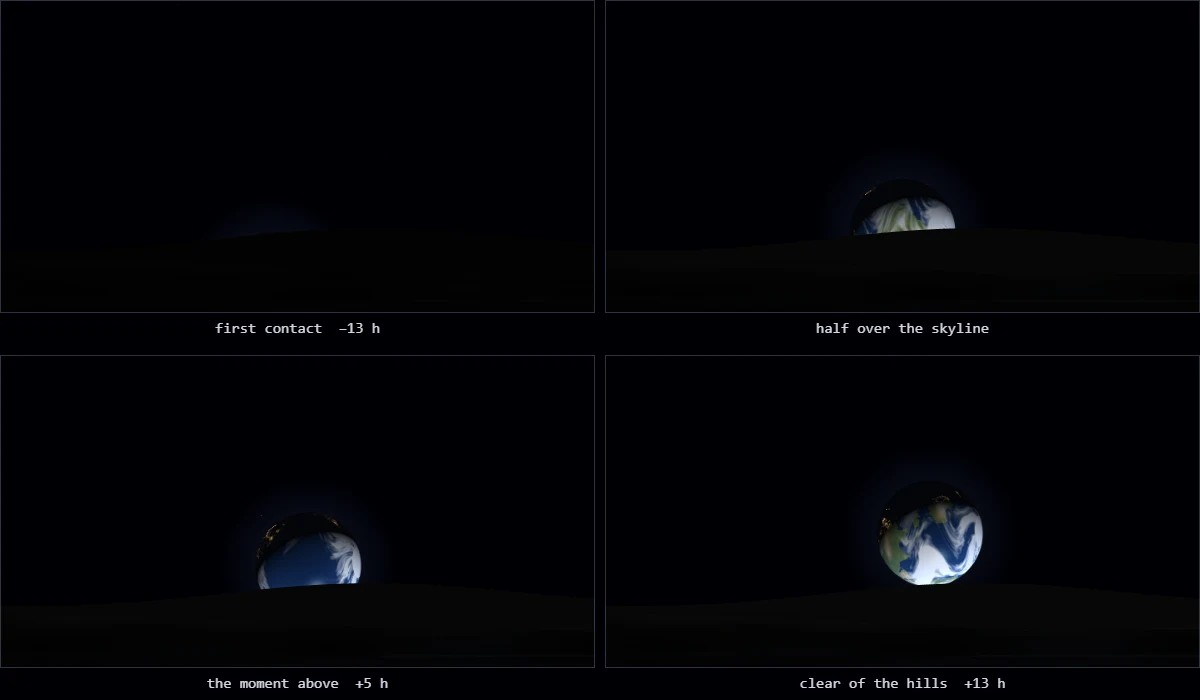
Slowly. From the one strip of the Moon where it happens at all, Earth takes about 25 hours to lift its whole disc clear of the skyline — a blue-and-white planet 1.81° wide, easing up out of grey hills — which here stand 0.8° above the horizon, so “the horizon” is a ridge line, not an edge — into a black sky. The render above is the next one, at Mare Orientale on 14 December 2026, computed by the same engine as everything else on these pages and running live in your browser.
What does an Earthrise look like?
Nothing like a sunrise. There is no air, so there is no glow before it, no colour on the horizon and no twilight: the sky is black before, during and after. It is also the middle of the night there — the Sun is 50.9° below the horizon — and that decides what comes up first. Earth’s lit side faces the Sun, which is down below the hills, so the top of the planet is its night side: a dark cap pricked with city lights clears the skyline first, and the bright day side, cloud and ocean, follows it up. This one is 78.95% lit and climbs at 1.7° a day, and the only light on those hills is coming off the planet rising over them.
That is slow enough that in real time it looks frozen. Leave the speed at real time and watch for a minute: nothing. Push it to six hours a second and the whole rise plays out in a few seconds. Both are true; the second is just the only one a person has the patience for.
Why Apollo 11 never saw one
Because they landed in the middle of the near side. The Moon keeps one face turned toward Earth, so from most of the near side Earth does not rise or set at all — it hangs in one spot, changing phase. At this same instant Earth stands 61.9° above the horizon over Tranquility Base, and across a whole month it wobbles through 15.71° of altitude without ever coming near the ground. Armstrong and Aldrin could have waited there a lifetime.
The famous Earthrise photograph was taken from orbit by Apollo 8, whose crew rose over the Moon’s horizon rather than waiting for Earth to rise over it — that story is here.
Where on the Moon Earth actually rises
Only near the edge of the near side. The Moon wobbles as it orbits — the effect is called libration — and at the rim that wobble is enough to carry Earth below the horizon and back. At Mare Orientale it climbs to 6.3° above the horizon at the top of its swing, and some of it is in the sky for about 12.7 days a month; the rest of the time it is below the hills. So an Earthrise is a place as much as a moment. Why Earth never rises anywhere else is its own page.
When is the next Earthrise?
About once a month at any one site on the limb, but most of them are not much to look at. When Earth is thin, almost all of what comes over the hills is its night side, and the planet is barely visible against the sky. The rise shown above is the first one after the start of October 2026 that is at least three-quarters lit — the same rule the app uses. The next few, whatever their phase:
| Earthrise | Earth lit |
|---|---|
| 10 Jan 2027, 10:12 UTC | 94% |
| 7 Feb 2027, 04:38 UTC | 100% |
| 6 Mar 2027, 17:45 UTC | 97% |
| 2 Apr 2027, 22:45 UTC | 84% |
| 30 Apr 2027, 00:40 UTC | 61% |
| 27 May 2027, 05:50 UTC | 37% |
Watch it yourself
The render at the top of this page is the real engine, not a video: the slider sets the speed from real time to two days a second, and Zoom & follow Earth keeps the planet centred as it climbs. Click the picture itself to open this exact moment in Lunar Aspect, where Jump to › Earthrise takes you to the next one from any date you like.
How these numbers were produced
Every figure on this page came out of the ephemeris that runs inside Lunar Aspect, computed for Mare Orientale at 2026-12-14 01:25 UTC. Nothing here was typed in by hand: the page is generated, and a number that the engine stops producing breaks the build rather than going quietly stale.
| Value | Produced by |
|---|---|
| 2026-12-14 01:25 UTC | first nextEvent("earthrise") at least 75% lit after 1 Oct 2026, bisected to most of Earth over the measured skyline |
| 0.8° above the horizon | read off a daytime render along Earth’s azimuth (figure.html skylineAt) |
| 14 December 2026 | the same instant |
| 78.95% | compute().earth.illum at the rise |
| 1.81° | compute().earth.angRad × 2 |
| 25 | upper limb touching the horizon to lower limb clear of it, bisected on earth.alt |
| 1.7° a day | earth.alt twelve hours after the rise − twelve hours before |
| 6.3° above the horizon | highest earth.alt in the month around the rise |
| 12.7 | hours with any of Earth above the horizon, same month |
| 50.9° below the horizon | compute().sun.alt at the rise |
| 61.9° above the horizon | compute().earth.alt at Tranquility Base, same instant |
| 15.71° | earth.alt at Tranquility Base over 30 days, max − min |
Engine build 596b875 2026-09-23 ·
page generated 2026-09-23 ·
positions are apparent, referred to the observing site rather than to the
Moon’s centre.
Move the date yourself
This page is one frozen moment. The engine that computed it runs on a phone, at any date, from anywhere on the Moon — the eclipses, the planets, the comets and Earth’s phase, all of it computed rather than canned.