
Supply Lines — a hand-drawn real-time strategy game for iPhone
a lightweight war, drawn in ink
Three supply lines.
That is the whole game.
Drag between two nodes and ink flows down the line you drew — a surge at once, then a steady pour for as long as you leave it open. Enough of it takes the node at the far end.
A supply line is not an attack you send. It is a commitment you make, and you only ever have three.

Or play demo here In browser only — no download.
- Free
- No ads
- Offline
- iOS 15+
- 21 MB
Google Play: coming soon.
The one rule
You are never short of ink. You are short of attention.
Every node you hold makes ink, all the time, and there is always more of it than you can spend. What there is never enough of is lines.
Three open at once. Every line you commit to the north is a line you cannot commit to the south, and the moment you decide the north is safe is usually the moment it stops being. Take a waystation and you get a fourth — which is why a waystation is the most valuable mark on the sheet.
Try it
One swipe cuts every line it crosses
Knowing when to cut your own is most of the skill. Ink already in transit down a severed line is ink you spent on nothing — so cutting is never free, and it is still right more often than it feels.
The board above is a moment lifted out of the same recorded match, and the gesture is the game's own. Cutting here changes nothing but the drawing.
No download
Or play the campaign right now, in this browser
The whole expedition — nine engagements, every doctrine, every opponent — runs in a tab. There is no account, no limit on how many campaigns you play, and nothing to install.
It takes over the screen, because the game is built for a phone held upright. On a computer it takes clicks instead of drags. Skirmish and the eleven hand-built charts are in the app.
The chart
What a node is worth is written on it
There is no build menu. A mark above a node is the whole message — this one is worth fighting for, and here is why.
-
Inkwell
Produces far more than an ordinary node. The economic prize, and the first thing a good opponent goes for.
-
Redoubt
Hard to take and hard to lose. Attacks land for a fraction of their damage, and it holds far more ink than a plain outpost.
-
Waystation
Raises your line limit. The only thing on the sheet that buys you back the one resource the game is stingy with.
How it plays
Ink arrives, defence divides it
Break the garrison and the surplus is yours
What lands is subtracted from what is there. A big commitment takes ground and holds it; a trickle just feeds a wall. Ground you take settles with a garrison of its own, so it does not fall straight back.
A win means the other side is gone
Nothing else ends a match. Holding most of the chart is not a victory and there is no clock — you win when every other commander has no ground left, however long that takes.
And then the ink runs dry
Past a couple of minutes every node produces faster while holding less. Garrisons thin everywhere and nobody can sit behind a full redoubt forever. It falls on both sides equally.
Unseen ground is smudged
You read exact numbers on your own nodes, on everything you border and on all unclaimed ground. What an enemy is massing further away is a smudge — so a forward node is worth holding for the view alone.
What is in it
A campaign, a skirmish, and eleven hand-built charts
- An expedition of nine engagements, drawn fresh each run, with a doctrine to take after every victory.
- Skirmish — choose the opponent, the difficulty, the size of the chart and how many sides fight over it, up to six.
- Eleven fixed charts: The Isthmus, The Ring, The Spine, The Ford, The Crossroads and six more, some deliberately lopsided.
- Opponents with habits, not just bigger numbers — the cartographer spreads, the red hand goes for the throat.
- A short tutorial that teaches by making you play, not by making you read.
- A drum corps that follows the fight, not the score. Bare taps while everyone is still spreading; the whole line at full cry when you are being overrun.
On a phone
Ink on paper, and nothing else
Nothing glows, nothing explodes, nothing shouts at you. The whole game is line weight and colour, and it was built to be quiet enough to think in.
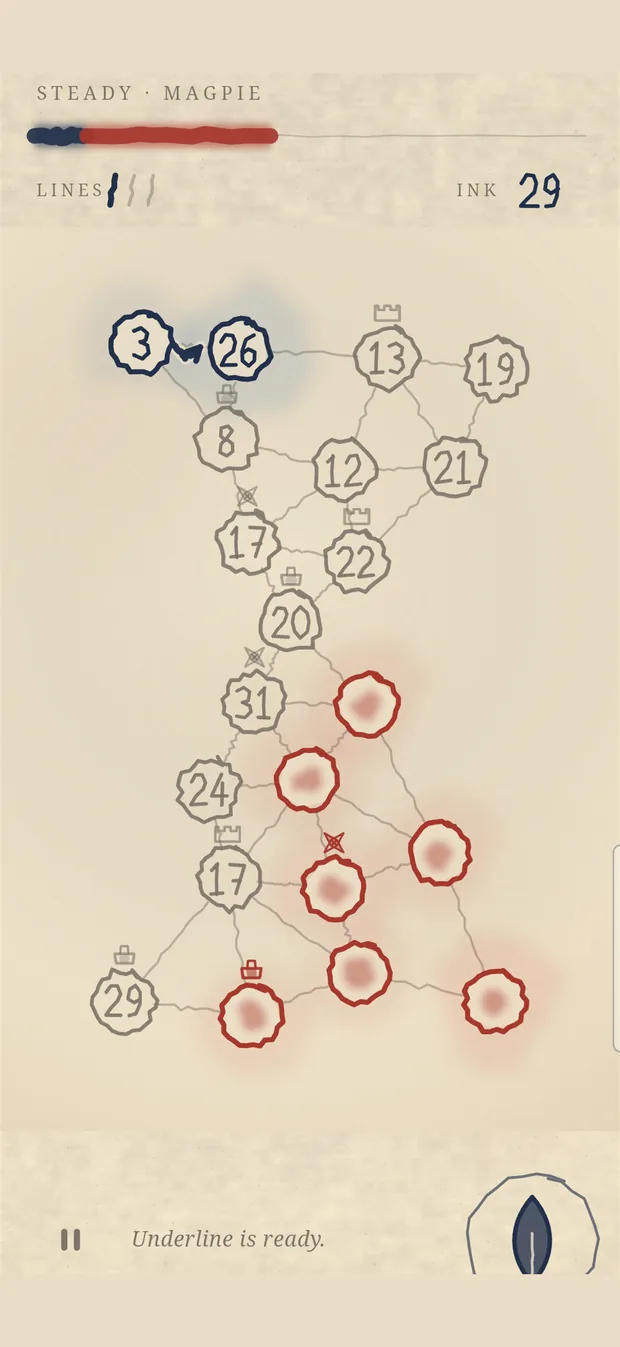 Mid-engagement
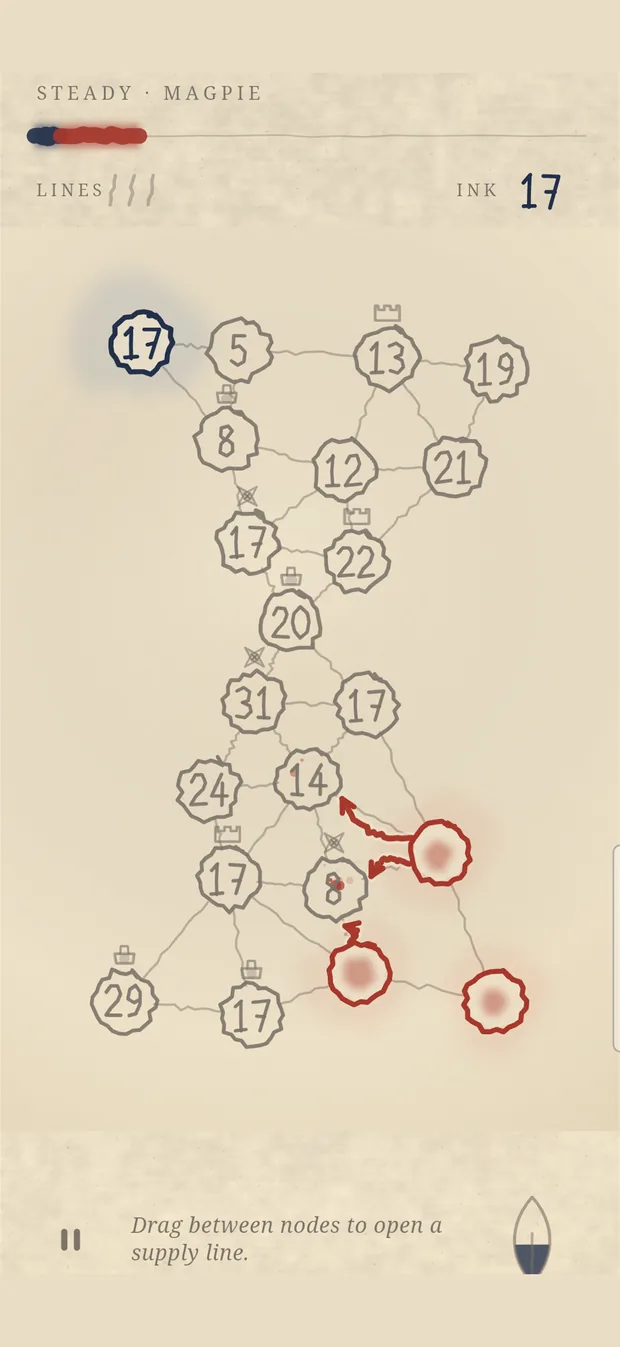 The opening
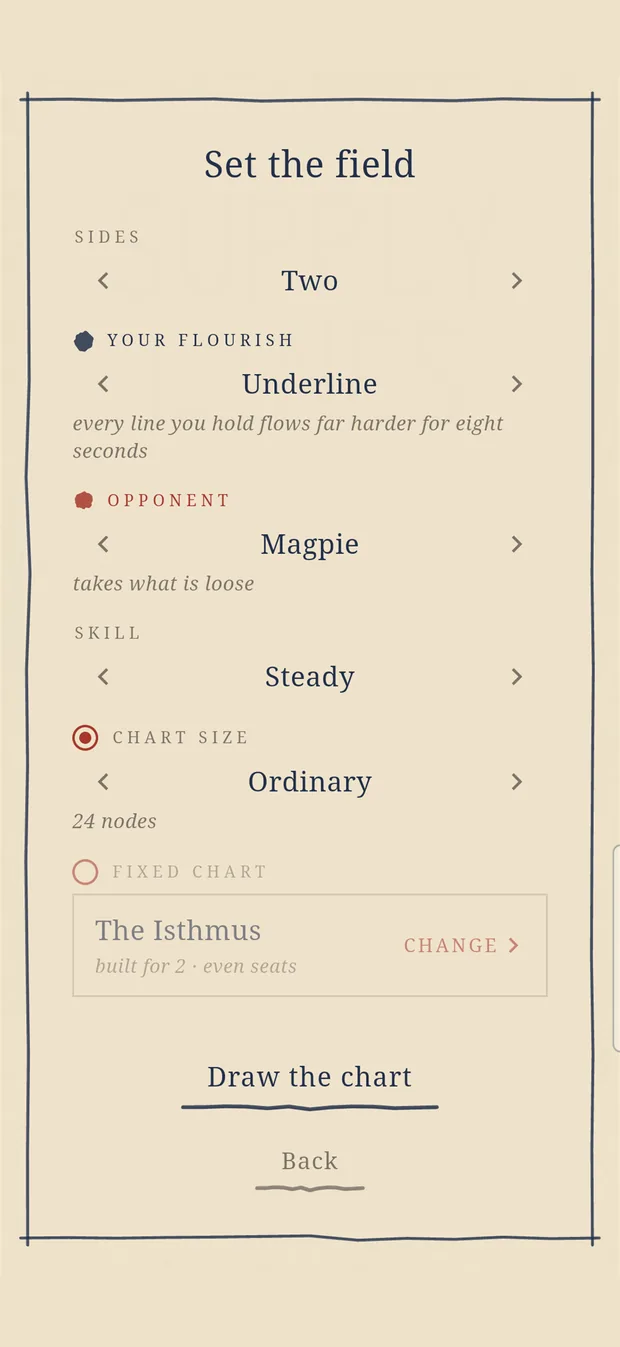 Set the field
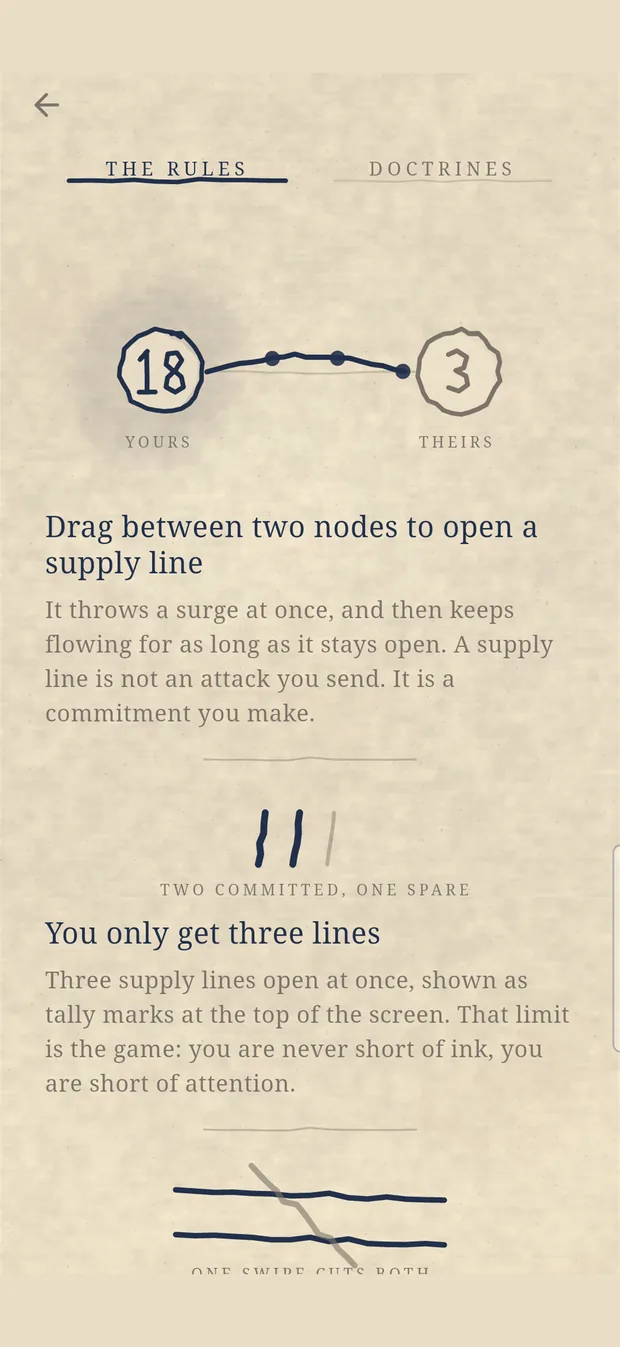 The rules
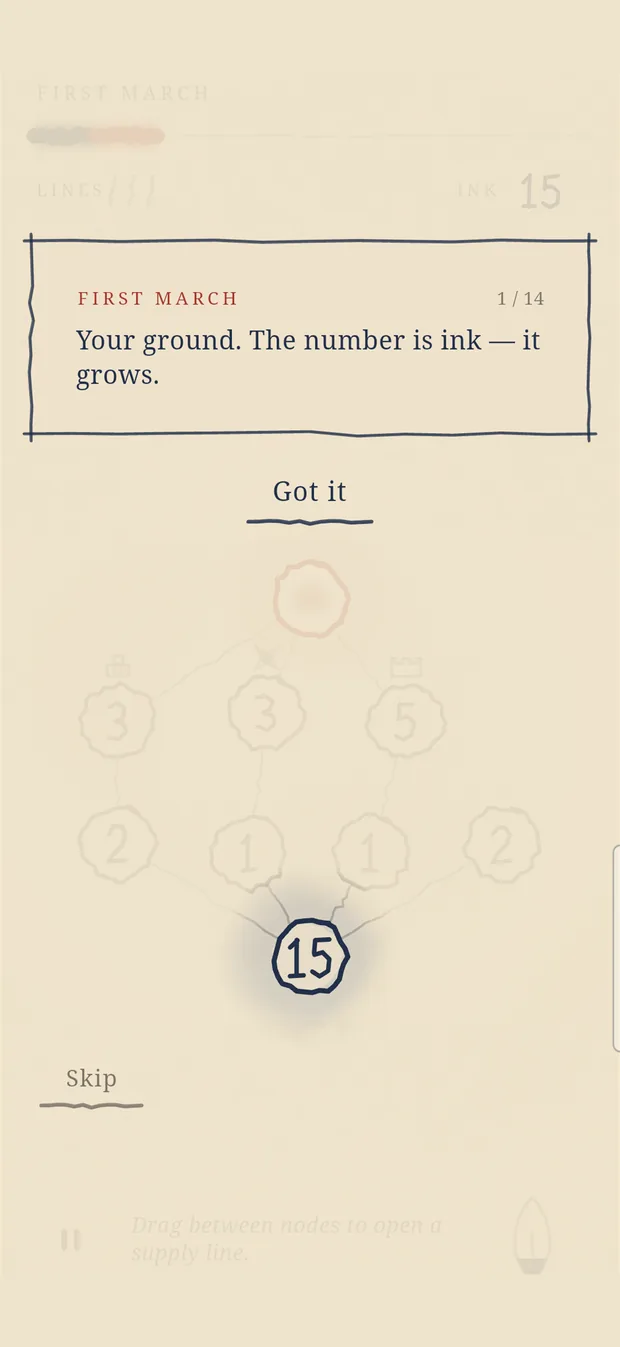 First March
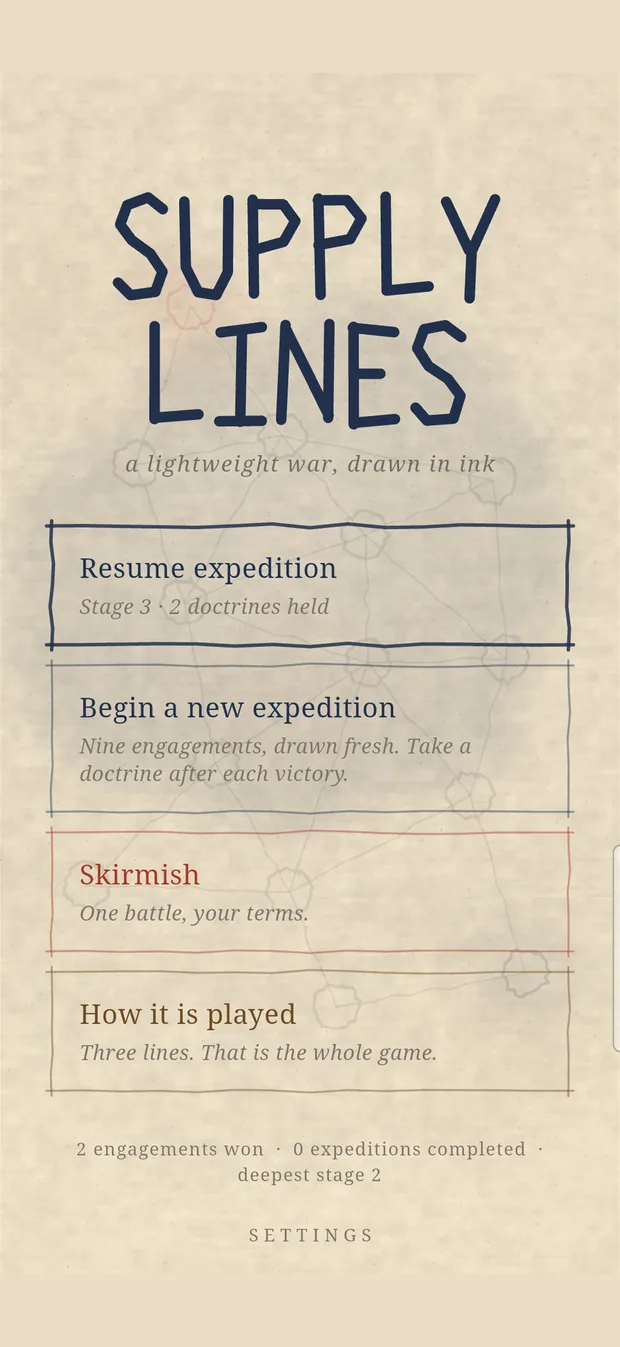 The title
What is not in it
No accounts. No ads. No network needed.
No login, no in-app purchases, no tracking, and nothing that identifies you. The iPhone app reports anonymous usage statistics — battles and expeditions played, won and lost — which you can switch off in Settings. The privacy policy lists every one.
It works on a plane, and it will keep working whether or not anyone keeps a server running. It is free, and it is the whole game.
Free on iPhone. Google Play coming soon.
Questions
Before you download it
- Is it free?
- Yes. Free to download, nothing to buy inside it, no advertising. It is the whole game, not a trial.
- Does it work offline?
- Entirely. It needs no network connection at all.
- Do I need an account?
- No. There is no sign-up, no login and no email address.
- Can I try it without downloading it?
- Yes — the campaign runs in your browser, free and with no account. Skirmish is the one mode that is only in the app.
- Is it on Android?
- Not yet. The iPhone version is out now; a Google Play release is coming.
- Is it turn-based?
- No — it runs in real time, but slowly enough to think in. Nothing in it is a race against a clock.
- How long is a match?
- A single engagement is a few minutes. An expedition is nine of them, and you can put it down in between.
- How do you win?
- By taking every node. Holding most of the chart is not a victory.
- Is it multiplayer?
- No. Single player, against opponents with distinct habits at five levels of skill.
Help and legal
- Support bugs, questions, and how to reach a human
- Privacy policy what the game collects, and what it does not
- support@bendigogames.com one person reads all of it
More from Bendigo Games
- One Shot Cascade one tap, nine seconds, read the board
- Lunar Aspect Earth and sky, from the Moon
- Squeeze the Orbs the jar is closing, and every merge wins back space
- Everything else the full catalogue